What the Sushi Counter Knows That Your Kitchen Doesn't: A Practical Guide to Sake Service
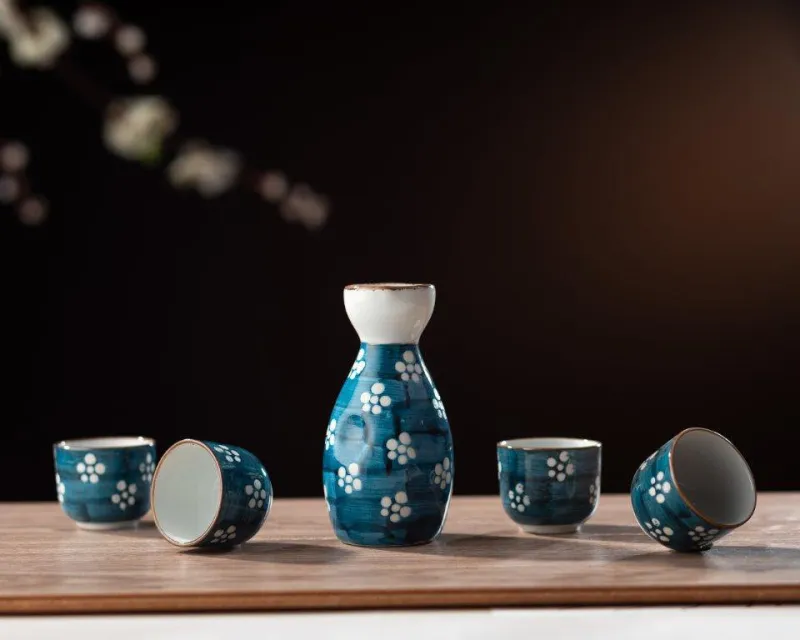
Photo: sake carafe ochoko ceramic cups sushi bar Japanese restaurant service, via assets.wfcdn.com
Consider a scenario that will be familiar to many American sake drinkers. You visit a sushi restaurant, order a small ceramic carafe of house sake warmed to just above body temperature, and find yourself genuinely delighted—relaxed, nourished, perfectly paired with your omakase. Two weeks later, you visit a specialty bottle shop, spend real money on a premium junmai daiginjo recommended by an enthusiastic employee, bring it home, pull it from the refrigerator, pour it into a white wine glass, and feel vaguely underwhelmed.
The bottle was almost certainly the better sake by any technical measure. So why did the sushi counter win?
The answer involves temperature, vessel, timing, context, and a set of quiet professional decisions that most restaurant drinkers never notice precisely because they are working so well. This guide makes those decisions visible—and gives you the tools to replicate them at home.
The Temperature Variable Is More Complex Than 'Hot or Cold'
American sake culture has largely settled into two camps: the warmed house sake served at sushi restaurants, and the chilled premium sake served at upscale Japanese restaurants or specialty bars. Both are legitimate. Neither tells the whole story.
Sake temperature is measured in Japan along a detailed spectrum with named stages. Tobikiri-kan (around 131°F) is the hottest common serving temperature, delivering an almost broth-like intensity. Atsu-kan (122°F) is what most American diners receive when they order 'hot sake.' Nuru-kan (around 104°F) is a gentler warmth that preserves more aromatic complexity. On the cold end, hana-hie (around 59°F) is considered the optimal temperature for many ginjo and daiginjo styles, while yuki-hie (around 41°F) is a deep chill that can suppress aromatics in more delicate sakes.
The reason warmed sake at a sushi bar often tastes so good has nothing to do with the quality of the sake being exceptional. It has everything to do with appropriateness. A straightforward honjozo or futsushu—an everyday drinking sake—often benefits from gentle warming because heat rounds out any rough edges, amplifies umami-forward notes, and creates a physical warmth that pairs intuitively with raw fish and vinegared rice. Serving that same sake ice-cold might expose textural flatness or a slightly industrial edge that warmth would have gracefully concealed.
Conversely, a premium daiginjo served warm is a small tragedy. The delicate fruit and floral esters that make it worth its price—ethyl caproate, isoamyl acetate, the fragile aromatic compounds produced by specialized yeast strains—are volatile. They dissipate rapidly with heat. What remains is alcohol and body, which is a significant fraction of what you paid for.
Vessel Choice Is Not Decorative
The ceramic ochoko or tokkuri that arrives at your sushi counter is not simply an aesthetic choice. Ceramic retains heat effectively, making it ideal for warmed sake service. It also does not conduct temperature to your hand the way glass does, which means the sake stays at its intended serving temperature longer.
For chilled premium sake, the vessel conversation becomes more interesting. Many Japanese restaurants now serve daiginjo in white wine glasses—specifically, a tulip-shaped glass that concentrates aromatics at the rim. This is a deliberate choice borrowed from wine service, and it works for the same reason: the tapered opening directs volatile esters toward your nose before the liquid reaches your palate, amplifying the perceived aroma dramatically.
At home, this is one of the easiest adjustments to make. If you are drinking a ginjo or daiginjo, reach for a white wine glass or a dedicated sake glass with a narrowing rim rather than a flat-bottomed tumbler. The difference in aromatic experience is immediate and significant.
For a junmai or honjozo that you plan to warm, a simple ceramic mug—if you do not own an ochoko—performs better than a glass vessel. The principle is thermal consistency, not authenticity.
How Restaurants Warm Sake (and Why Your Microwave Is Wrong)
The standard professional method for warming sake is a hot water bath. The tokkuri or serving vessel is placed in water heated to approximately 175°F and left for two to three minutes, allowing the sake to warm gradually and evenly to the target temperature. This gentle approach preserves the sake's character while achieving the desired warmth.
Microwaving sake creates uneven hot spots, can scorch the liquid at the container walls, and introduces the kind of harsh, thin quality that gives warmed sake an undeserved bad reputation among drinkers who have only encountered the microwave version. If you are warming sake at home, a small saucepan with hot water and a ceramic vessel takes less than five minutes and produces a dramatically better result.
Target temperature matters. For most everyday sakes, aim for 104°F to 113°F—warm to the touch but not aggressively hot. A simple instant-read thermometer, the kind used for candy making or coffee, costs under fifteen dollars and removes the guesswork entirely.
Timing: The Gap Between Purchase and Pouring
Sommeliers understand that wine needs time to open after being opened—and that some bottles need time to settle after transport. Sake shares a version of this sensitivity, though the dynamics are different.
Premium ginjo and daiginjo sake, once opened, are best consumed within two to three days. Unlike wine, sake does not meaningfully benefit from extended air exposure. Oxidation is generally an enemy of the delicate aromatic compounds that define premium styles. A forty-dollar bottle left open in the refrigerator for a week will taste noticeably flatter than the same bottle consumed over two evenings.
At a sushi counter, the house sake is typically a high-volume product that turns over quickly. You are almost never drinking something that has been open for days. At home, unless you are sharing a bottle with guests, you may inadvertently be drinking sake well past its post-opening prime.
Practical solution: purchase smaller formats when possible. The 300ml bottle—widely available at Japanese grocery stores and specialty retailers in most American cities—is sized for a single serious drinking occasion and eliminates the leftover problem entirely.
What the $15 Carafe Is Actually Selling You
The sushi restaurant is not just selling you sake. It is selling you a complete service experience: the right temperature, the right vessel, the right food context, and the right pacing. The sake arrives after your order, alongside food designed to complement it, in a setting calibrated for relaxed enjoyment. All of those contextual factors shape how the sake tastes.
Replicating that at home requires attention to the same variables, not necessarily the same budget. Choose a sake appropriate to what you are eating. Serve it at the temperature that suits its style. Use a vessel that supports rather than undermines its aromatics. Drink it fresh. These are not expensive interventions. They are informed ones.
The gap between a forgettable home sake experience and a memorable one is rarely the price of the bottle. It is almost always the care taken in serving it.