The Smoothness Paradox: Understanding Why Sake at 16% ABV Feels Nothing Like Wine at 16% ABV
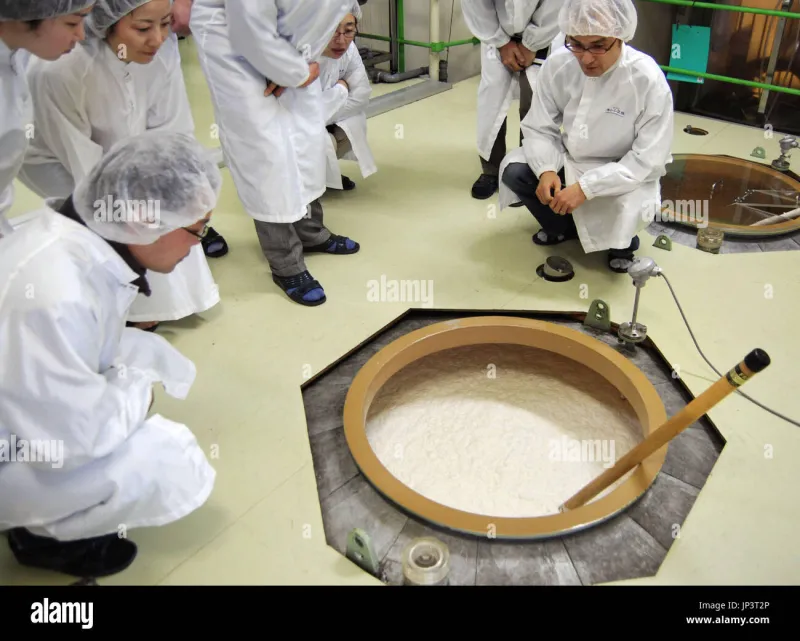
Photo: sake brewing fermentation rice koji mold Japanese brewery close-up, via c8.alamy.com
Consider two glasses on a table. One contains a full-bodied California Zinfandel at 15.5% ABV. The other holds a well-made junmai daiginjo, also at approximately 15.5% ABV. A drinker who picks up the wine first will feel the alcohol almost immediately — a warmth at the back of the throat, a slight burn, a weight that signals strength. When the same drinker picks up the sake, the experience is disorienting in the best possible way. The alcohol is present, but it is somehow quieter. The liquid feels lighter, cleaner, and more integrated. The strength is there, but it does not announce itself.
This is not imagination. It is not the placebo effect of expectation. It is the direct result of how sake is made, and understanding the distinction requires a genuine look at fermentation chemistry — the kind of behind-the-scenes knowledge that transforms a casual drinker into an informed one.
The Chemistry of Perception: Why ABV Is Not the Whole Story
Alcohol by volume is a straightforward measurement: it tells you what percentage of the liquid in your glass is ethanol. What it does not tell you is how that ethanol is distributed, what surrounds it at the molecular level, or how the other compounds in the beverage interact with your sensory receptors to modulate the perception of alcohol's heat.
In wine, ethanol exists alongside tannins, phenolic compounds, residual sugars, and — particularly in high-ABV reds — congeners produced during fermentation that contribute to the aggressive, warming sensation many drinkers associate with alcohol. The ethanol in wine is, in a sense, relatively unmediated. It reaches your palate in a fairly direct form.
Sake's fermentation environment produces something structurally different. The beverage's production method — a simultaneous saccharification and fermentation process unique in the world of brewing — generates an extraordinarily complex molecular matrix. Within that matrix, ethanol molecules are effectively surrounded and cushioned by a dense population of amino acids, organic acids, and sugars. These compounds do not reduce the alcohol content. They change the way alcohol is perceived.
Parallel Fermentation: The Process That Changes Everything
To appreciate why sake's molecular structure is so distinctive, it helps to understand what makes its brewing method unlike anything else in the beverage world.
In beer production, brewers first convert grain starches to sugar (saccharification), then introduce yeast to ferment those sugars into alcohol — two sequential steps. In wine, the sugars are already present in the grape juice, so fermentation is relatively straightforward. Sake production, by contrast, accomplishes both saccharification and fermentation simultaneously in the same vessel. The mold Aspergillus oryzae (koji) continuously breaks down rice starch into fermentable sugars while yeast converts those sugars to alcohol in real time, side by side.
This parallel process results in fermentation tanks that reach alcohol concentrations of up to 20% — among the highest achieved by any naturally fermented beverage in the world, without distillation. More importantly for our purposes, it produces a liquid saturated with byproducts of both processes: a rich population of amino acids from the koji's enzymatic activity, organic acids from yeast metabolism, and complex sugars that were never fully fermented.
This biochemical density is the foundation of sake's perceived smoothness. The ethanol does not disappear, but it is integrated into a matrix so complex that the palate registers the whole rather than the parts.
The Role of Amino Acids in Softening Alcohol's Edge
Amino acids deserve particular attention in this discussion. Sake contains free amino acid concentrations significantly higher than those found in most wines or beers — a direct consequence of the koji's enzymatic breakdown of rice proteins during fermentation. These amino acids serve multiple functions in the finished beverage.
First, they contribute to the perception of body and texture. A sake with a high amino acid count will feel rounder and more viscous on the palate, which effectively distributes the sensation of alcohol across a broader sensory surface rather than concentrating it at the throat. Second, certain amino acids — particularly glutamic acid, the primary driver of umami — interact with taste receptors in ways that actively moderate the perception of astringency and heat. The same mechanism that makes umami-rich foods feel satisfying also makes umami-rich beverages feel gentler.
This is why two sakes at identical ABV levels can feel dramatically different. A cheap, mass-produced sake made with added distilled alcohol (known as a honjozo or, at lower quality levels, a futsushu) will often contain fewer amino acids and a less integrated molecular structure. The alcohol in such a product may feel sharper or more pronounced. A premium junmai — made without added alcohol and with careful attention to fermentation conditions — will typically feel markedly smoother at the same ABV, not because it contains less ethanol, but because the ethanol is better integrated.
What High-Quality Brewing Actually Looks Like
For American consumers navigating sake shelves that have grown considerably more populated in recent years, this science translates into several practical evaluation tools.
Rice polishing ratio (seimaibuai): Labels on premium sake will indicate the percentage of the rice grain remaining after polishing. A daiginjo, polished to 50% or less, removes the outer layers of the rice grain that contain proteins and fats which can produce harsh flavors during fermentation. More polishing generally — though not universally — correlates with a cleaner, more refined alcohol integration. However, polishing alone does not guarantee quality.
Junmai designation: The word junmai on a label indicates that no distilled alcohol was added during brewing. This is not an absolute indicator of smoothness, but it does mean that the beverage's character is entirely a product of fermentation rather than fortification. For consumers prioritizing integration and naturalness, junmai expressions are a reliable starting point.
Amino acid content (SMV and acidity): Some import labels, particularly those distributed through premium sake specialists, will include the sake meter value (SMV) and acidity level. These numbers, read together, offer a rough guide to the beverage's structural balance. A sake with moderate acidity and a neutral to slightly negative SMV (indicating some residual sweetness) will typically feel rounder and less alcohol-forward than a highly acidic, dry expression.
Why Price Does Not Always Predict Smoothness
One of the more counterintuitive findings for American consumers is that the most expensive sake is not always the smoothest. Highly polished daiginjo expressions are often extraordinarily delicate and aromatic, but their refinement can make certain structural elements — including alcohol — more perceptible rather than less, because there is less surrounding complexity to mediate the sensation.
Some of the smoothest, most integrated sake experiences come from mid-range junmai or junmai ginjo expressions where the brewer has prioritized fermentation quality and amino acid development over extreme rice polishing. A $25 bottle from a small, craft-oriented producer may offer a more seamlessly integrated drinking experience than a $60 highly polished daiginjo from a prestigious house — depending entirely on the individual drinker's palate and priorities.
The practical takeaway is this: approach sake evaluation with curiosity rather than price-point assumptions. Taste broadly. Note how the alcohol registers — whether it arrives as a distinct sensation or simply as warmth diffused across the entire experience. That diffusion, when it occurs, is the fermentation chemistry doing exactly what centuries of Japanese brewing tradition designed it to do.
Tasting with New Eyes
The smoothness paradox is ultimately an invitation. It asks the American drinker to set aside the familiar metrics — ABV numbers, price points, country of origin — and engage with what is actually in the glass at a sensory level. The science explains why sake feels the way it does. The tasting is where that understanding becomes personal.
Begin with a well-made junmai ginjo served chilled. Notice the way the alcohol integrates. Compare it, if you are able, to a wine of similar strength. The difference is not subtle. Once you have felt it, the question of why becomes irresistible — and that curiosity is precisely where genuine sake appreciation begins.